

If your employees save just 30 minutes of Excel work per person per week, that adds up to over 1,000 hours a year for a team of 50.
Most users utilize Excel far below its potential because they have never been shown how to use it correctly. They sort manually instead of filtering. They type in values instead of importing them via queries. They build reports by hand instead of using pivot tables. And they do not notice when formulas produce incorrect results during copying.
This is exactly where this course bundle comes in. In three compact courses, Holger Wöltje shows you how to use Excel in a way that truly simplifies your work – and does so in a way that allows you to apply what you have learned immediately in practice.
Not everyone needs Excel every day. But when a project suddenly requires a clean analysis, the need is immediate – and the video courses are available right when it counts.
Excellent courses, quickly implementable
The courses follow a consistent principle: showing exactly the functions that make the biggest difference – in a way that allows you to apply what you have learned immediately. No theory marathons describing every useless button in detail. No functions that you might use only once in ten years. Instead, it provides exactly what your employees need in their daily routine, what truly saves time and creates better clarity.
Excel Basic Course (approx. 85 minutes)
Anyone who has rarely worked with Excel – or wants to refresh their basic knowledge before moving on to more demanding topics – will find the right starting point here.
You will learn, among other things:
- how an Excel file is structured and how to navigate confidently through workbooks, sheets, columns, and rows,
- how to customize the user interface to your workflow and save yourself unnecessary clicks,
- how to format text and numbers so that tables are understandable at first glance (including currencies, negative values in red, and cleanly rounded displays for exactly stored values),
- how to use AutoFill to automatically complete month series and recurring values instead of typing them in,
- how to use simple formulas, the sum function, and the average – and why a total row in tables is later the key to correct sub-totals when filtering,
- how to create a meaningful chart in just a few clicks and customize it specifically.
Excel Advanced Course I (approx. 70 minutes)
Building on the basic course, the first advanced course shows how raw data can be turned into reliable evaluations in a short amount of time.
You will learn, among other things:
- how to use filters and slicers to focus on the essentials without changing your original data,
- how to use text filters with wildcards as well as AND/OR logic precisely,
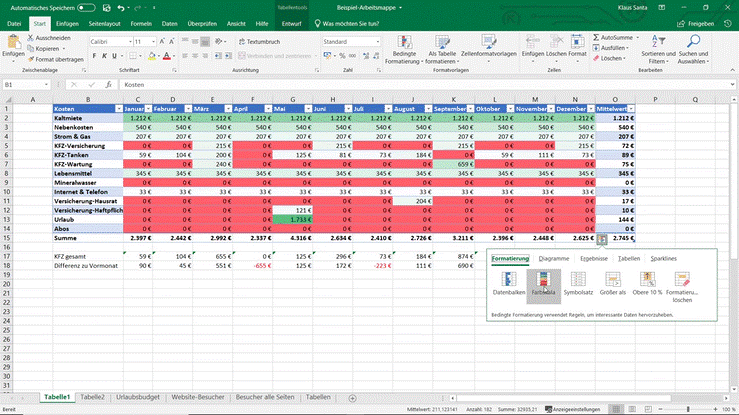
- how to use Quick Analysis to insert bars, color scales, and icons into your data in seconds, making connections visible that would be lost in pure columns of numbers,
- how to quickly detect errors caused by accidentally overwritten formulas,
- how to cleanly import address lists (e.g., from newsletter systems) – even with international character sets where other import methods fail,
- how to use Power Query to import data via query and later update it with a single click instead of setting up the import from scratch every time.
Excel Advanced Course II (approx. 105 minutes)
Building on the first two courses, this second advanced course focuses on the functions that save the most time in practice – and where users without good guidance stumble most often.
You will learn, among other things:
- how to import project appointments from your Outlook calendar and calculate monthly working hours from them (including typical pitfalls with appointments past midnight and totals exceeding 24 hours),
- how to prepare an Outlook view so that exporting to Excel works smoothly as a representative example for any external tools,
- how to use relative and absolute cell references correctly – the difference often determines whether a formula provides correct results when copied or calculates nonsense unnoticed,
- how to customize conditional formatting in detail, for example, to highlight the top five percent of a value range in color or to display bars only above a certain threshold,
- how to use lookups to add customer data based on a customer number or look up tiered shipping costs – and the pitfalls of approximate matches,
- what pivot tables are and why it is worth taking the time to become familiar with them: you can evaluate data according to various criteria in seconds, move fields via drag-and-drop, and present your results clearly with slicers and timelines.
Start Effective Further Training for Your Employees
On the screen in the office, in the home office, or on the go. Self-paced, guided, or as a fixed component of your professional development plan. For individual team members, a department, or the entire company.
You have a choice for delivery: learning directly on Holger Wöltje’s platform, or integration into your own LMS, e.g., as a SCORM or xAPI package. Individual MP4 video files are also possible.
Request your demo access now and see for yourself.
P.S.: A one-day Excel seminar usually reaches up to ten participants and requires everyone to be available at the same time. With this course bundle, you can train dozens of colleagues simultaneously – at their own pace and at a fraction of the cost per person.
P.P.S.: Your team will no longer curse Excel, but master it. Start now with your demo access. Call directly